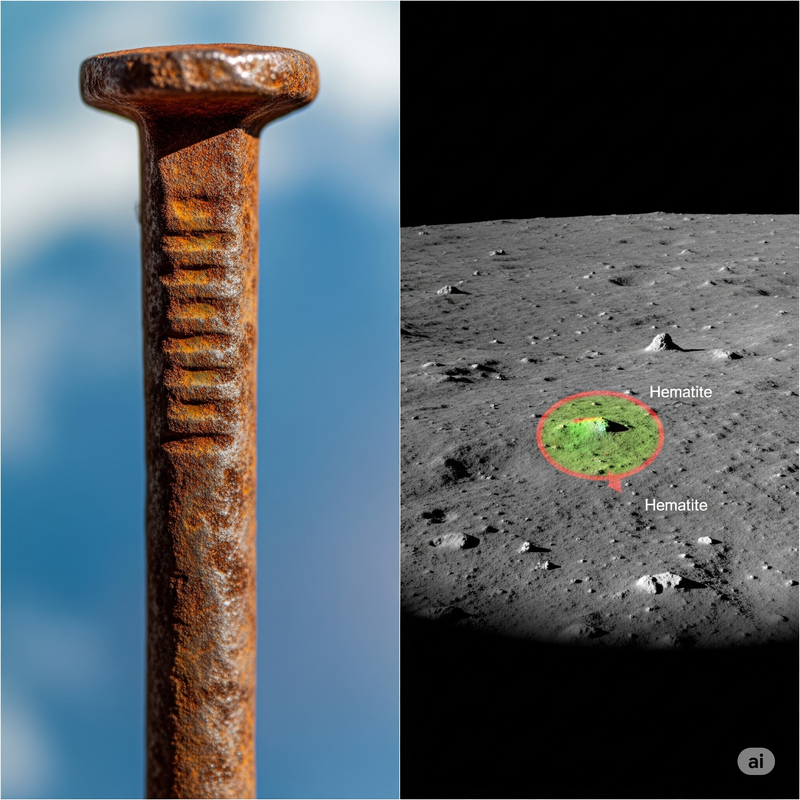
Rust on the Moon? It sounds like something from a sci-fi movie gone wrong. After all, rust, or iron oxide, famously requires two key ingredients: oxygen and water. Our Moon, a barren, airless celestial body bombarded by harsh solar winds, is thought to lack both of these in significant amounts. Yet, in a revelation that sent ripples through the planetary science community in 2020, scientists using data from India's pioneering Chandrayaan-1 mission made a shocking discovery: unmistakable traces of hematite (Fe₂O₃), a form of iron oxide, on the lunar surface.
This perplexing finding isn't just a quirky anomaly; it profoundly challenges what we thought we knew about lunar geology and opens up exciting new avenues for understanding the intricate dance between Earth and its celestial companion.
What Exactly Is Rust, and Why Is It So Weird on the Moon?
Rust is a common chemical reaction on Earth, but a profound riddle on the Moon.
On Earth, we see rust everywhere – on old cars, forgotten tools, and metal structures. It's the result of a chemical reaction called oxidation, specifically the corrosion of iron when it's exposed to oxygen and moisture. The basic chemical formula for common rust is:
Here's the catch: the Moon is a vacuum. It has no atmosphere to provide oxygen, no liquid water on its surface, and it's constantly bombarded by the solar wind – a stream of charged particles (mostly hydrogen ions) from the Sun. These hydrogen ions are highly reductive, meaning they tend to add electrons to materials, making it incredibly difficult for oxidation (which involves losing electrons) to occur.
Solar wind should actively prevent rust from forming! The presence of hematite on the Moon isn't just weird – it's a profound scientific paradox that forced researchers to completely rethink the lunar environment.
The Chandrayaan-1 Discovery
The groundbreaking detection of hematite came from data collected by the Moon Mineralogy Mapper (M3) instrument aboard India's Chandrayaan-1 orbiter, launched in 2008. Researchers from NASA's Jet Propulsion Laboratory (JPL) and the University of Hawai'i meticulously analyzed spectroscopic data, identifying the distinct spectral "fingerprints" of hematite [1].
Particularly intriguing: the hematite was found at higher lunar latitudes and near the poles – regions less exposed to direct solar radiation and potentially richer in hidden water ice.
The Science Behind Moon Rusting: An Earthly Connection
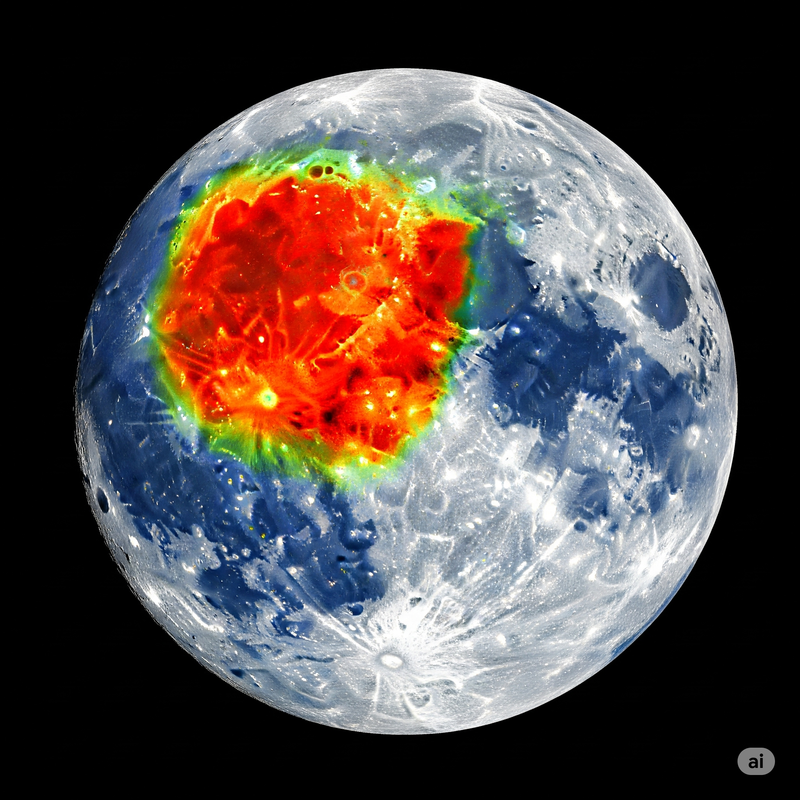
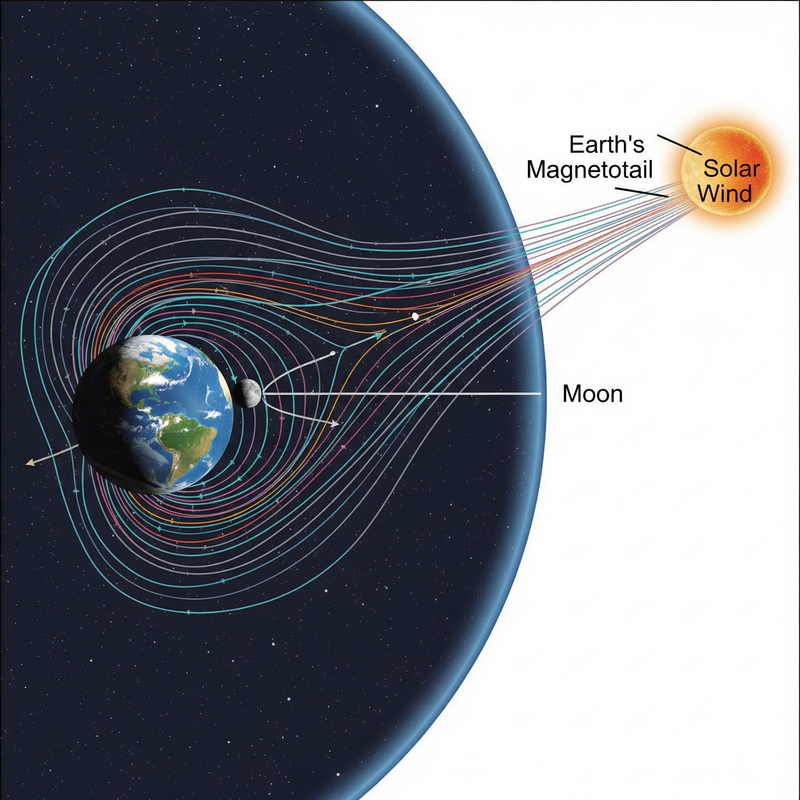
Earth's magnetotail plays a crucial role in supplying oxygen to the Moon and shielding it from solar wind.
To explain this seemingly impossible phenomenon, scientists have pieced together a compelling hypothesis involving a surprising interaction between Earth and its Moon. The theory involves three critical components:
1. Source of Oxygen: Earth's Atmospheric Gift
Where could the oxygen possibly come from? The leading theory points to Earth itself. Our planet's magnetic field creates a vast protective bubble called the magnetosphere, which extends far into space. On the side away from the Sun, this magnetosphere stretches into a long, comet-like structure known as the magnetotail, reaching up to 400,000 kilometers (250,000 miles) – far enough to engulf the Moon.
During specific periods of its monthly orbit (roughly five days around the full Moon), the Moon passes through this magnetotail. When this happens, Earth's upper atmosphere actually leaks trace amounts of oxygen ions into space, which are then carried by the magnetotail's plasma to the lunar surface [2].
While not a strong "wind," this intermittent flow provides just enough oxygen to kickstart the oxidation process – but only during specific windows when the Moon is shielded by Earth's magnetotail.
2. Source of Water: Hidden Lunar Hydration
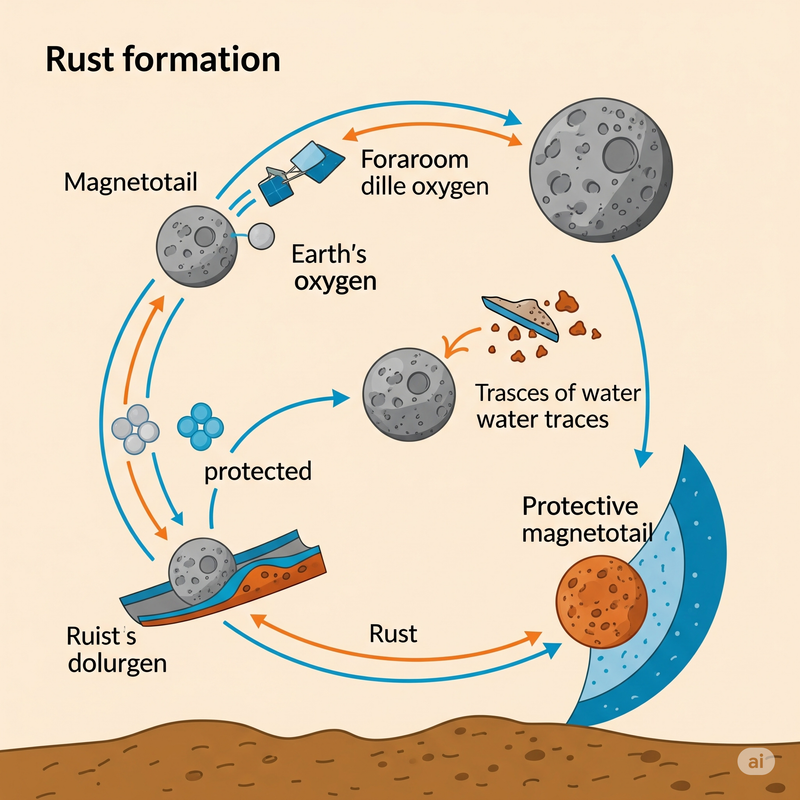
Trace amounts of water on the Moon, especially at the poles, are vital for rust formation.
Even with oxygen, rust still needs water. While the Moon is dry, it's not entirely devoid of water. Scientists have found evidence of water ice hidden in permanently shadowed craters at the lunar poles, and there's also ubiquitous evidence of hydroxyl (OH) and water molecules adsorbed onto the lunar regolith.
These trace amounts of water could come from several sources:
- Micrometeorite Impacts: Tiny meteorites hitting the Moon carry small amounts of water, which can be vaporized and then settle into cold traps.
- Solar Wind Interaction: While the solar wind primarily carries hydrogen, it can interact with oxygen atoms in lunar dust to form hydroxyl (OH) or even water (H₂O) molecules in tiny, localized reactions [3].
- Lunar Interior: There's also speculation about water trapped deep within the Moon's mantle, slowly outgassing over time.
3. Shielding from Solar Wind: The Protective Pause
The solar wind is a double-edged sword for rust. Its hydrogen ions are highly reductive, meaning they readily donate electrons, actively preventing iron from losing electrons (oxidizing) and thus stopping rust from forming. However, when the Moon passes through Earth's magnetotail, it gets a crucial reprieve.
During this period, the Moon is largely shielded from the constant barrage of solar wind hydrogen [2]. This temporary "shelter" reduces the reductive environment, allowing the oxygen and trace water to react with the lunar iron, giving hematite a window of opportunity to form.
Three conditions must align for rust to form on the Moon:
-
1. Oxygen Supply
Earth's magnetotail delivers oxygen ions during full moon phase -
2. Water Presence
Trace water from micrometeorites or solar wind interactions -
3. Solar Shield
Magnetotail blocks hydrogen ions that prevent oxidation
Why This Discovery Is So Important
The finding of Moon rust isn't just a quirky scientific footnote; it has profound implications across several fields of planetary science:
- Rethinking Earth-Moon Interactions: This discovery unequivocally demonstrates that Earth's magnetic and atmospheric environment extends far enough to have a tangible chemical impact on the Moon. It reveals a more dynamic and interconnected relationship than previously understood.
- Clues About Lunar Water Sources: The existence of hematite strongly supports the idea that the Moon might harbor more accessible water than previously thought. This boosts prospects for in-situ resource utilization (ISRU) – future colonists might extract water, oxygen, and hydrogen directly from lunar materials.
- Insights into Planetary Evolution: Studying how rust forms on an airless body provides unique insights into oxidation processes on other celestial objects like asteroids or the moons of Mars.
- Revisiting Lunar Geology: The presence of hematite challenges older assumptions about the Moon's interior, suggesting some internal processes might bring oxidized iron to the surface.
The Future of Moon Rust Research & Exploration
This rust-colored enigma opens a fascinating new chapter in lunar science. Future missions are eager to dig deeper:
NASA's Artemis program, aiming to return humans to the Moon, and subsequent robotic missions like India's Chandrayaan-3 and future lunar landers, are designed to gather direct samples from the lunar poles and other regions. Analyzing these samples will allow scientists to study the precise composition, age, and formation mechanisms of hematite and other unexpected lunar minerals.
What do you think causes the Moon to rust? Do you believe Earth influences the Moon more than we realize, or are there other lunar secrets waiting to be uncovered?
Frequently Asked Questions
Got more questions about rust on the Moon? Click to expand answers.
📚 Scientific Sources & Further Reading
- JPL, NASA. (2020, September 2). NASA Finds Moon is Rusting. https://www.jpl.nasa.gov/news/nasa-finds-moon-is-rusting
- Xu, Y., et al. (2020). Earth's Oxygen Influences Moon's Hematite Formation. Science Advances, 6(41), eaba1950. https://www.science.org/doi/10.1126/sciadv.aba1950
- Honniball, C. I., et al. (2020). Molecular water detected on the sunlit Moon by SOFIA. Nature Astronomy, 4, 1146–1152. https://www.nature.com/articles/s41550-020-1198-x
- ISRO. (n.d.). Chandrayaan-1 Mission. https://www.isro.gov.in/Chandrayaan1.html


